
There are celebrity deaths that feel distant in a way that’s hard to explain without sounding cold. You see the headline, you register it, you think that’s sad, and then the day keeps moving. The world has trained us to process loss at scroll-speed.
But every once in a while, one lands different. It doesn’t feel like news. It feels like someone quietly turned a key inside you and opened a door you forgot existed.
Gil Gerard died, and I wasn’t prepared for how hard it hit.
Maybe that sounds ridiculous to people who didn’t grow up with Buck Rogers in the 25th Century in their bloodstream. Maybe it sounds like nostalgia doing what nostalgia does. But this wasn’t just “an actor I liked.” This was a particular piece of childhood—one of those warm, bright anchors—suddenly becoming something you can only visit, not live alongside.
And it’s December, which makes everything heavier.
The holidays have a way of putting your life on a loop. The same music. The same lights. The same half-remembered rituals you didn’t realize you’d been collecting for decades. This time of year doesn’t just bring memories back; it drags them in by the collar and sets them down in front of you like, Look. Pay attention.
So when I saw the news, it didn’t feel like losing a celebrity.
It felt like losing a doorway.
Buck Rogers wasn’t a show I watched. It was a place I went.
Some shows are entertainment. Some are comfort. And some become the background radiation of your childhood — you don’t even remember the first time you saw them, because they feel like they were always there.
That’s what Buck Rogers was for me.
It was shiny, goofy, sincere, and somehow confident enough to be all three without apologizing. It was the future as imagined by a world that still believed the future could be fun. It had that late-70s/early-80s optimism baked into the sets and the pacing — like even the danger had a little wink in it.
And in the middle of all of that was Gil Gerard.
His Buck wasn’t “perfect hero” energy. He was cocky in a way that felt survivable. He was charming without being smug. He had that specific kind of grin that said: Yeah, this is insane — but we’re gonna be fine. As a kid, that matters more than you realize. A character like that doesn’t just entertain you; he teaches your nervous system what “okay” can feel like.
When you grow up, you start to understand why you clung to that.
Princess Ardala, obviously
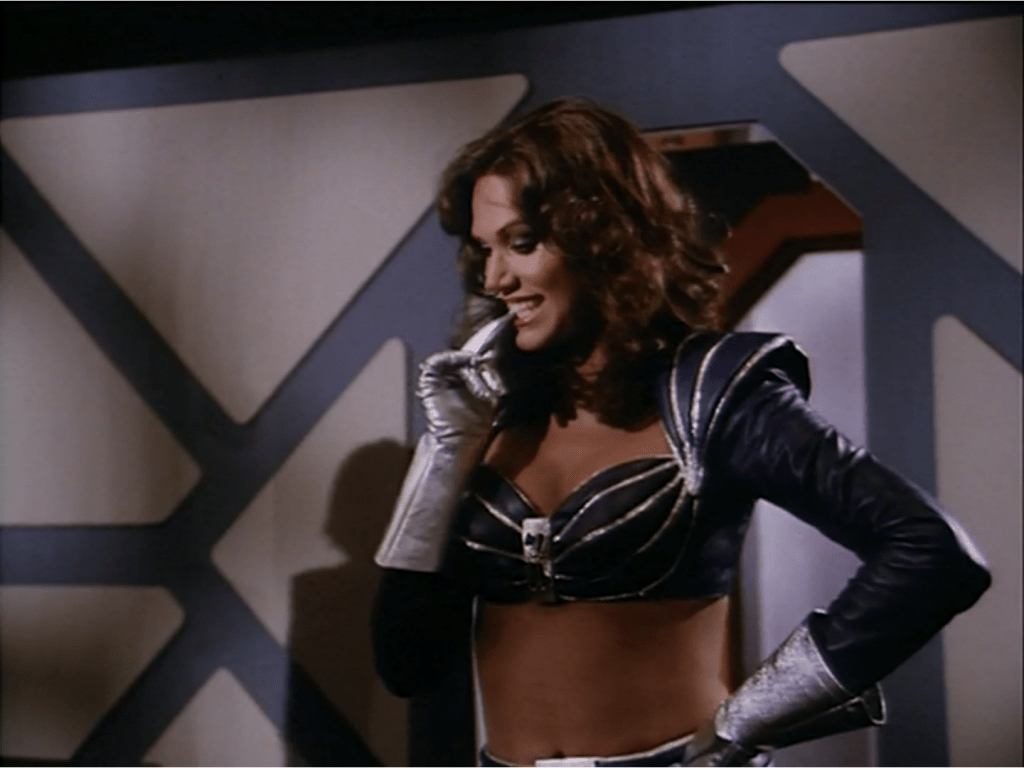
And yes — Princess Ardala.
I’ve written about my love for her plenty, and I’m not stopping now. Ardala wasn’t just a villain. She was glamour with teeth. She was command presence and mishelpful desire and that intoxicating confidence that makes you root for someone even when you know better.
She was also part of why the show stuck in my brain the way it did. Ardala made Buck Rogers feel like it had adult electricity under the hood — like it understood that charm and danger can share the same room.
But here’s the thing I don’t think I appreciated until now: Ardala worked because Buck worked.
You need the center to make the orbit matter. You need someone steady enough to make the outrageous feel real. Gil Gerard was that steady. He didn’t overplay it. He didn’t flinch from the camp. He just stood there in the middle of it — smirking, sincere, game for the ride — and that’s what made the whole thing click.
So when he goes, it isn’t just “Buck is gone.” It’s like the whole little universe loses its gravity.
Why it hurts more in the holidays
Because December is already full of ghosts.
It’s the month where you catch yourself standing in a familiar room and realizing time has been moving faster than you’ve wanted to admit. It’s the month where you see an ornament and suddenly remember a person’s laugh. It’s the month where a song can knock the wind out of you in a grocery store aisle.
Holiday nostalgia is sneaky. It doesn’t feel like sadness until it does.
And Gil Gerard’s death—right now, right in the middle of the season that already has you looking backward—feels like a confirmation of something you spend most of the year successfully ignoring:
That childhood is not a place you can go back to. It’s a place you carry. And sometimes, someone you associated with that place disappears, and the weight of it finally shows up.
Not because you knew him.
Because you knew you, back then.
And you miss that kid more than you expected.
What I’m doing with it
I’m not trying to turn this into a big philosophical thing. I’m just being honest about the shape of the grief.
It’s not the grief of losing a family member. It’s not the grief of losing a friend. It’s its own strange category: the grief of realizing another thread connecting you to your early life has been cut.
So I’m going to do the only thing that makes sense.
I’m going to watch an episode.
Not in the “content consumption” way. In the ritual way. The way you replay something not because it’s new, but because it reminds you that you’ve been here before — you’ve felt wonder before, you’ve felt comfort before, you’ve felt the world get a little lighter for an hour before.
I’ll let the show be what it always was: a bright, weird little pocket of imagination that helped shape me.
And I’ll feel the sting of knowing that time only moves one direction.
Rest in peace, Gil Gerard.
Thanks for being a part of the version of the world where the future felt fun — and where I did, too.
This post was written with assistance from ChatGPT 5.2

 Christopher Finlan